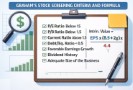
Investors might be interested in the so-called “father of value investing”, Graham Formula and Screening Criteria. I’ll explore this in this post, and let you know what’s the return rate if applied Graham Formula and Screening Criteria.
Key Points from Security Analysis
In the first edition of “Security Analysis“, Graham translated his market views into specific screening criteria for selecting undervalued stocks. While subsequent editions of “Security Analysis“ have slightly adjusted these criteria, the following ten points represent the original format:
- Price-to-Earnings Ratio (P/E Ratio) No more than twice the yield of AAA-rated bonds.
- Stock P/E Ratio No more than 40% of the average P/E ratio of all stocks over the past five years.
- Dividend Yield Greater than one-third of the yield of AAA-rated bonds.
- Stock Price Less than one-third of tangible book value.
- Stock Price Less than two-thirds of net current asset value (NCAV), defined as highly liquid assets including cash, less current liabilities.
- Debt/Equity Ratio (Book Value) Must be less than 1.
- Current Assets Greater than twice current liabilities.
- Debt Less than twice net current assets.
- Earnings per share have grown at a rate greater than 7% over the past 10 years.
- Earnings have not declined for more than two years in the past 10 years.
The formula in Value Investing
The formula is presented in Benjamin Graham’s biography “Benjamin Graham on Value Investing“, written by Janet Lowe. If you are interested in this book, you can refer to my post, ““Benjamin Graham on Value Investing”, Graham’s bio book“.
In her biography of Graham, Janet Lowe mentions that while Graham’s teaching emphasized practical examples, he also mentioned some investment maxims. These nine maxims can be considered the primary commandments of value investing:
- Be an investor, not a speculator. Graham believed that investors buy companies from a long-term perspective, while speculators are concerned with short-term profits.
- Pay attention to the selling price. Even the best company can be an unwise investment if the price is wrong (too high).
- Look for bargains in the market; the market makes mistakes.
- Strictly adhere to discipline and buy using the following formula:
E(2g + 8.5) × Treasury Yield / Y
Where E represents earnings per share (EPS), g represents the expected earnings growth rate, Y represents the AAA corporate bond yield, and 8.5 represents the price-to-earnings ratio applicable to companies with no growth potential. For example, consider a stock with 2012 EPS of $2, an earnings growth rate of 10%, a 2% Treasury yield, and a AAA-rated Treasury yield of 3%. In this case, the formula would be:
Price = $2.00(2 × 10 + 8.5) × 2/3 = $38.00
If the stock price is below $38, consider buying.
- Don’t blindly trust company-reported data.
- Diversify your investments; don’t concentrate all your bets on a single or few stocks.
- If in doubt, stick to quality.
- Protect shareholders’ interests; he was one of the earliest advocates of corporate governance.
- Be patient. This directly extends from the first maxim.
What are the actual returns?
How did stocks selected according to Graham Formula and Screening Criteria perform? Henry Oppenheimer studied the performance of portfolios built based on these selection criteria from 1974 to 1981, finding that these portfolios did indeed outperform the market annually. Data scientists have also tested these individual selection criteria in recent years—for example, a low price-to-earnings ratio and a high dividend yield—and found that they can indeed improve portfolio returns.
Indeed, some have attempted to convert these selection criteria into mutual funds, hoping to create even higher returns. In the 1970s, an investor named James Rea, a firm believer in this value-based selection criterion, established a mutual fund called “Rea-Graham,” specifically investing in stocks that met Graham’s selection criteria. This net liquid fund initially performed quite well, but by the 1980s and early 1990s, the situation reversed, and its performance fell into the bottom 50%.
Related articles
- “Graham Formula and Screening Criteria“
- ““Benjamin Graham on Value Investing”, Graham’s bio book“
- “The career annualized return on investment of top investment masters: Buffett, Simons, Lynch, Dalio, Keynes, Munger, Soros, Miller, Karaman, Graham“
- “Imitating great investors is the fastest and most effective way“
- “Investing has no formulas, but there are ways to invest successfully“
- ““Benjamin Graham on Value Investing”, Graham’s bio book“
- “Buffett’s Acquisition Criteria“
- “The commonalities of Buffett portfolio – cheap, fixed income, repurchase“
- “Possibility of long-term holdings, Deep dive on Buffett’s case“
- “People believe successful investors are survivorship bias cannot succeed“
- “Why Buffett deserves further study?“
- “What helps Buffett to get his investment idea?“
- “Why most mergers and acquisitions end in failure?“
- “Why Buffett prefers minority stake to entire company?“
- “Institutional imperative – the good, bad, and ugly“
- “Berkshire’s acquisition model“
- “Advantages of controlled business“
- “Buffett’s 2025 Berkshire Shareholder Letter“
- “Buffett’s 2024 Annual Shareholder Letter“
- “Buffett’s 2023 Annual Shareholder Letter“
- “2024 Berkshire shareholders meeting transcript and video“
- “2023 Berkshire shareholders meeting transcript and video“
- “Charlie Munger speaks at 2023 Daily Journal Shareholders Meeting“
- “Buffett’s first TV interview“
- “Full transcript of Buffett’s interview with CNBC’s Squawk Box“
Disclaimer
- The content of this site is the author’s personal opinions and is for reference only. I am not responsible for the correctness, opinions, and immediacy of the content and information of the article. Readers must make their own judgments.
- I shall not be liable for any damages or other legal liabilities for the direct or indirect losses caused by the readers’ direct or indirect reliance on and reference to the information on this site, or all the responsibilities arising therefrom, as a result of any investment behavior.