About the Author
Who is Joel Greenblatt?
Author of the book “The Little Book That Still Beats the Market” Joel Greenblatt is a scholar, fund manager, value investor and author.
Gotham Capital
He runs Gotham Asset Management with partner Robert Goldstein. In 2008, Gotham Asset Management was established as the successor company to Gotham Capital’s investment advisory business.
Between 1985 and 1994, Greenblatt achieved an astonishing annual return of 50% at Gotham Capital. Gotham Capital’s event-driven investment has an IRR of 50% over the past 10 years, and even the worst year has been 28.5%.
Greenblatt later decided to return the profits to investors. Because he found that Gotham Capital’s event-driven investment had too much capital, which affected its performance. If it switched to value investment, this phenomenon would not occur.
Another famous book
Gotham Capital specializes in special situation investments such as spinoffs and other corporate restructurings. For more information on how he invests in this area, please see Greenblatt’s other book, “You can be a stock market genius“.
Greenblatt quotes
- It is not necessary to trade.
- The future profits of the technology industry are unclear and difficult to analyze, so what should we do? Greenblatt said: To find another suitable company, investors must know what they know, this is the key.
About this book
Reason to recommend
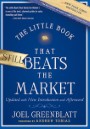
The book “The Little Book That Still Beats the Market” is written by Joel Greenblatt. An “interesting” book on value investing written by Joel Greenblatt.
Key points of the book
The book introduces a story by Joel. The investment strategy of “magic formula” investment invented by Greenblatt. The method is simple: just buy “cheap and good companies” with high profit yields and high returns on invested capital.
Add up the performance rankings of the two financial indicators, ROC and EBIT, of all companies, with the best being 1, and so on. Finally, find the top 20 companies with the smallest sum of the two financial indicators’ performance rankings and invest in them. The method is simple and the rewards are amazing! But you must hold it for at least one year, during which you can add to your investment every one or three months. But the problem is that people are unwilling to hold for the long term, or do not accept all the companies in the ranking results and add or subtract them on their own, so few people will actually follow Greenblatt’s operations.
According to multiple studies around the world, Greenblatt’s formula tends to lead to long-term outperformance relative to the market average, but because he concentrates his investments on 20 to 30 stocks, it can also lead to significant increases in short-term volatility and large declines.
Magic Formula website
To save investors the trouble of selecting stocks on their own, in October 2009, Greenblatt launched the “Formula Investing” website, which provides online tools for following the investment strategies described in his book. Investors just need to follow the stock selection instructions on the website.
Greenblatt’s Advice on the “Magic Formula”
Significant Discovery
Greenblatt tracks the performance of self-managed portfolios relative to the performance of portfolios managed by others (he is referring to the portfolios automatically picked for investors by “magic formula” websites). On average, portfolios managed by others outperformed self-managed portfolios (that is, portfolios automatically selected by self-modification) by 25%.
Although the holdings of both portfolios come from the same list of stocks. The difference in sustained effectiveness between others-managed and self-managed investments reflects the impact of human selection and timing decisions.
Do not modify it
Investors who do not simply “adopt” the automatically selected stocks of the formula as is, and who arbitrarily modify the stocks and make their own decisions, will perform significantly worse.
What is the reason?
Why do investors who make their own decisions perform worse? Greenblatt responded: “When the market goes down, people reduce their exposure. They often sell stocks when individual stocks or portfolios are underperforming. Their selections may perform relatively poorly compared to a portfolio of stocks randomly selected from a list, perhaps because they avoid stocks that are particularly painful to hold, and as a result they miss out on the real winners.”
Why is this so?
Greenblatt’s “magic formula” experiment unexpectedly confirmed Eckhart’s argument: monkeys performed better than investment decisions made by humans themselves.
Closing words
Decisions that make investors comfortable often do not produce better returns.
Relative articles
- “The Little Book That Still Beats the Market”
- “The Art of Speculation”
- “Jesse Livermore’s Methods Of Trading In Stocks”
- “Stock Market Wizards“
- ““A Random Walk Down Wall Street” is a must-read for US stock investors“
- “How to Invest”
- “Best Loser Wins”
- “Charles Ellis and his “Winning the Loser’s Game”“
- “Great primer books for Investing in the stock market“
- ““One Up on Wall Street”, Peter Lynch’s great book for investing newbie“
- ““Benjamin Graham on Value Investing”, Graham’s bio book“
- “Great primer books for Investing in the stock market“
Disclaimer
- The content of this site is the author’s personal opinions and is for reference only. I am not responsible for the correctness, opinions, and immediacy of the content and information of the article. Readers must make their own judgments.
- I shall not be liable for any damages or other legal liabilities for the direct or indirect losses caused by the readers’ direct or indirect reliance on and reference to the information on this site, or all the responsibilities arising therefrom, as a result of any investment behavior.