I suggest you read my two previous posts before reading below two posts:
- “Pros and cons of Open Weights, Open, and Closed AI models, and top vendors”
- “Chinese AI progress and top companies“
Companies support Open Weights AI model?
Open Letter to Support
Dozens of tech giants, startups, and research institutions jointly signed an open letter on June 24th titled “Open Weights and American AI Leadership,” strongly urging U.S. policymakers not to suppress “open-weight” AI models.
This open letter, released on Friday, comes as the White House weighs whether to ban Chinese open-source companies on national security grounds.
Key Points of the Open Letter
The open letter points out that while it may appear to be just an industry initiative, it actually addresses several key issues, including preventing startups from being tied to a single model vendor, expanding competition from the model layer to the cloud and chip layers, advocating that technological transparency helps with security governance, and defending the “knowledge distillation” technique (using the output of a large model to train a smaller model), emphasizing that this is a long-standing and legitimate practice in research and should not be considered infringement or theft.
Who signed the open letter?
Within just a few days, the number of companies signing the letter surged from an initial 25 to over 70, accumulating over 60 million views. This also clearly demonstrated for the first time that Silicon Valley’s AI industry has formed two distinct camps along the “open model” and “closed model” paths.
This open letter was unusually joined by almost all of America’s tech giants, including Nvidia, Microsoft, Meta, Alphabet, OpenAI, A16z, Dell, Palantir, Cisco, IBM, GitHub, and the Linux Foundation, among 32 other organizations.
Heavyweight figures such as Jensen Huang of Nvidia, Satya Nadella of Microsoft, Elon Musk of Tesla, Turing Award winner Yann LeCun, and AI scholar Andrew Ng all signed in support, making it arguably the largest collective statement from the AI community in recent years.
Who hasn’t signed?
Among prominent tech companies, only Anthropic has yet to express its support. However, on July 27th, Anthropic CEO and principal founder Dario Amodei finally spoke out, stating that they have never advocated banning the Open Weights model and explicitly stated their opposition to blocking it.
However, he disagrees with the view that the Open Weights model is more advantageous to network defenders or makes it easier for users to build security mechanisms. In other words, Anthropic does not fully agree with the industry’s attitude and the views expressed in the open letter; Anthropic does not fully support the Open Weights model.
The key point is that Anthropic opposes opening it to Chinese Companies and advocates for a ban on the export of AI chips to China.
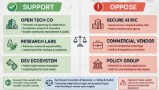
Main Reasons for Support and Opposition
Typical Reasons for Opposition
It’s noteworthy that Anthropic’s absence stands out in this almost collective wave of support.
As a representative company of the closed-source camp, Anthropic not only failed to join the petition, but its employee Julian also publicly expressed disapproval of the open-source camp on X, directly prompting a response from Andrew Ng.
Andrew Ng stated that any company has the right to choose not to release its code, but has no right to prevent others from choosing open source.
Reasons Corporate Support
Microsoft and other signatories stated in the letter that Open Weights broadens access to the AI economy, pointing out that organizations can build on advanced models without having to train them from scratch or pay for them.
Open Weights promotes competition, ensuring that the benefits of AI are widely shared, rather than concentrated in the hands of a few players.
Open Weights allows every organization to match the right model to the right task at the right cost, reserving frontier-scale capabilities for truly cutting-edge problems and running efficient, specialized models everywhere else.
Meta CEO Mark Zuckerberg stated on July 28, 2026, that banning cutting-edge Chinese AI is not an “effective solution,” adding that U.S. companies should “systematically” identify bottlenecks and barriers in order to better compete with Chinese AI companies.
It’s all about commercial interests
The Open Letter’s Demands
The open letter’s demands are quite direct: it calls on the industry to support the development of the “open weights” model and opposes a blanket restriction on open-source AI models by regulatory authorities.
The core stance conveyed in the letter can be summarized in one sentence: regulatory agencies should not restrict the development of the open weights technology route to prevent risks that have not yet occurred.
Most American Companies Would Benefit
80% of American AI startups use open-source AI models from China. The Little Tech Association, comprised of nearly 200 Silicon Valley startups, has urged the Trump administration not to restrict Chinese open-source AI technology.
The White House’s reported consideration of banning Chinese AI models from the US market has triggered widespread panic in the Silicon Valley startup community. Nearly 200 Silicon Valley companies, including the well-known startup accelerator Y Combinator, jointly wrote to President Trump on July 22, warning that a comprehensive ban would cause hundreds of American startups to “die instantly,” while allowing a few AI giants like Anthropic to reap the benefits.
The Interests of Companies
Chip and hardware manufacturers such as Nvidia and Dell Technologies are most concerned about whether the demand for computing power will continue to expand. As more and more companies choose to deploy and fine-tune open weighted models themselves, the demand for hardware procurement and cloud computing power will also rise accordingly. This is the fundamental motivation behind Nvidia’s strong support for open source.
Cloud service and enterprise software providers like Microsoft and Palanti hope to enrich their cloud platform product lines with open weight models, freeing enterprise customers from being tied to a single API vendor and thus keeping them within their cloud and subscription service ecosystems.
The open-source camp and ecosystem infrastructure providers, led by Meta, aim to gain control over technology standards through open models (such as the Llama series); startups like Mistral and Hugging Face are also using this to attract enterprise customers previously monopolized by closed-source giants.
Venture capital firms like a16z and Y Combinator worry that if the underlying models remain controlled by a few closed-source companies for a long time, the profit margins for application-layer startups will be significantly compressed. Therefore, they strongly support open weight models to ensure that startups still have bargaining power regarding costs and business models.
Anthropic’s Reasons for Not Signing
It is widely believed that Anthropic’s reserved attitude towards open weight models is highly related to its business model.
The company’s revenue and valuation are largely based on the scarcity of its model capabilities. Once a viable alternative open-source model emerges in the market, the premium pricing of its APIs and the capital market’s expectations for its growth potential may be impacted. Furthermore, how regulatory policies will be handled in the future remains a variable that the open-source community must continue to address.
Related articles
- “Pros and cons of Open Weights, Open, and Closed AI models, and top vendors”
- “OpenAI, the Generative Artificial Intelligence rising star and ChatGPT“
- “The king of AI Alphabet (Google) “
- “The pros and cons of investing in Alphabet amid AI evolution“
- “DeepSeek routed the global AI and stock“
- “Chinese AI progress and top companies“
- “Chinese tech singularity or just a flash in the pan? From DeepSeek, Huawei, TikTok, to Game Science“
- “The Importance of Small Language Models (SLM) in AI, how is Apple AI different from others?“
- “China ditch US AI chips and decides to go its own way“
- “AI inference chips vs. training chips“
- “Comparison of AI chips GPU and ASIC“
Disclaimer
- The content of this site is the author’s personal opinions and is for reference only. I am not responsible for the correctness, opinions, and immediacy of the content and information of the article. Readers must make their own judgments.
- I shall not be liable for any damages or other legal liabilities for the direct or indirect losses caused by the readers’ direct or indirect reliance on and reference to the information on this site, or all the responsibilities arising therefrom, as a result of any investment behavior.