Suggest you read “How cheap are Chinese AI models cost?” and “Chinese AI progress and top companies” before move on this post.
Definition of Open Weights, Open, and Closed
Before reviewing the support matrix, it helps to distinguish how these three deployment models differ in practice:
- Closed System (Proprietary): The model weights, code, and training data are private. Access is provided strictly via hosted APIs or platforms (e.g., ChatGPT, Claude API).
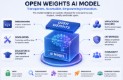
- Open Weights: The trained parameters (weights) are released for download so you can run, host, or fine-tune the model locally. However, complete training datasets, data filtering pipelines, or full training code are generally withheld, and usage may be governed by custom community/commercial licenses.
- True Open Source: Complete transparency — model weights, source code, and training recipes/data formats are fully released under OSI-approved permissive open-source licenses (e.g., Apache 2.0, MIT).
Top AI Companies Support Matrix
| Company | Closed System | Open Weights | Open Source (OSI Approved) | Notable Models / Key Notes |
| Meta (Muse Spark, Llama ) | No | Yes | Partial | Flagship Llama series released as open weights under Meta’s Community License (not strictly OSI due to commercial usage caps). |
| DeepSeek | Yes | Yes | Yes | Offers hosted APIs (DeepSeek-V3/R1), but releases weights, architecture, and code under permissive MIT licenses. |
| Zhipu AI (GLM) | Yes | Yes | Yes | Operates hosted platforms while releasing open-weight models (GLM-4 / GLM-5 series) under permissive MIT licenses. |
| MiniMax | Yes | Yes | Yes | Operates commercial APIs while publishing open-weight architecture releases (MiniMax-M1 / M3 series) under permissive open licenses. |
| ByteDance(TikTok) | Yes | Yes | Yes | The overall strategy is to primarily use closed APIs, supplemented by some open-source APIs. |
| Mistral AI | Yes | Yes | Yes | Hybrid strategy: proprietary APIs (Mistral Medium) alongside permissive Apache 2.0 / MIT models (Mistral 7B, Mixtral). |
| Moonshot AI (Kimi) | Yes | Yes | Yes | Provides API platforms (Kimi) while releasing open-weight architectures (Kimi K-series) under permissive open licenses. |
| SpaceX.AI (Grok) | Yes | Yes | Partial | Hosted frontier models (Grok-3/4), but released open weights for Grok-1 and open-sourced developer tools like Grok Build. |
| OpenAI (ChatGPT) | Yes | Yes | No | Primary focus on closed systems (GPT-4o, o1), with selective open-weight releases (GPT-OSS-120B/20B, Whisper). |
| Anthropic (Claude Fable,Mythos,Opus,Sonnet) | Yes | No | No | Strictly closed-system API offerings (Claude 3.5 / Opus). Rejects open-weights releases due to safety concerns. |
| Google (Gemini) | Yes | Yes | Partial | Closed frontier models (Gemini) alongside an open-weight model family (Gemma) under custom terms. |
| Alibaba (Qwen) | Yes | Yes | Yes | Offers API services while releasing the Qwen series as open weights/open source under Apache 2.0. |
Industry Trends
- Hybrid Approach: Most companies maintain closed, commercial API platforms for their absolute flagship models while offering smaller or specialized open-weight variants for developer ecosystem growth.
- Strictly Closed: Anthropic remains one of the few top-tier frontier developers maintaining an exclusively closed system model.
Advantages of Open Weights
Technical Advantages
Unlike closed AI systems, open weights models allow developers and enterprises to download pre-trained parameters (called weights) and run them on their infrastructure. Essentially, this concept is similar to the open-source software movement that revolutionized computing decades ago.
Unlike fully open-source AI, open weights models typically provide pre-trained model weights but don’t necessarily release the underlying training data or source code.
Three heads are better than one
Cybersecurity defenders need advanced AI to combat increasingly sophisticated attacks. Open weights models allow more researchers to identify vulnerabilities, improve security measures, and independently test systems, rather than relying solely on the original developers.
Reduced Costs, Making It Easier to Use
Training advanced AI models can cost billions of dollars. Open weights models address this challenge by allowing developers to build on existing AI models instead of creating them from scratch. This lowers the barrier to entry for smaller companies in the AI field.
Promoting Competition
Open weighted models not only encourage competition among AI developers, but also among cloud service providers, chip manufacturers, software companies, and AI application developers.
“This competition stimulates innovation, reduces costs, and broadly extends the benefits of AI to our economy,” because open-source AI lowers the cost of building AI products.
Opponents’ Arguments
The US is inclined to ban open weighted models
OpenAI and Anthropic have recently been actively lobbying the US government, warning of the potential risks posed by Chinese open-source AI models. According to five sources familiar with the matter, they specifically mentioned the potential threat posed by Chinese open-source AI models to the US. US Treasury Secretary Scott Bessent and President Trump’s science and technology advisor, Michael Kratsios, have also participated in discussions about protecting US AI technology.
Industry push back, US give up to ban
On August 6, 2026, Bloomberg, citing sources familiar with the matter, reported that the White House had informed major US artificial intelligence (AI) companies that the new AI security framework being developed by the Trump administration would not subject “open weights” models to government security testing, and that related models developed by mainland Chinese companies would also be applicable. This decision was communicated to industry representatives at a closed-door meeting held by the White House on Thursday.
Protecting Vested Interests
Creators of closed AI models like OpenAI, Anthropic, and Alphabet face clear economic incentives to maintain exclusive control over their top technologies.
US wants to keep its AI hegemony
The US Fears Loss of Control
Former Google CEO Eric Schmidt admitted that China’s open-source AI is no longer under US control, and the gap has narrowed from the previously estimated one to two years to only about six months. He acknowledged that US control over Chinese chip hardware is “beginning to fail,” and the gap between Chinese AI models and top US technology has narrowed from the previously estimated one to two years to only about six months, which is almost negligible in the development of AI. What worries him even more is that China’s full embrace of the open-source path in AI means it is “no longer under US control.”
China Will Soon Overtake US with Open Weighted
Clément Delangue, co-founder and CEO of Hugging Face, the world’s largest open AI platform, said on August 3, 2026, that China has taken the lead in the AI race, especially in the field of “open weighted” models, and at the current pace, it may overtake the US in advanced models by the end of this year or next year.
Related articles
- “Pros and cons of Open Weights, Open, and Closed AI models, and top vendors”
- “How cheap are Chinese AI models cost?“
- “OpenAI, the Generative Artificial Intelligence rising star and ChatGPT“
- “The king of AI Alphabet (Google) “
- “The pros and cons of investing in Alphabet amid AI evolution“
- “DeepSeek routed the global AI and stock“
- “Chinese AI progress and top companies“
- “Chinese tech singularity or just a flash in the pan? From DeepSeek, Huawei, TikTok, to Game Science“
- “The Importance of Small Language Models (SLM) in AI, how is Apple AI different from others?“
- “China ditch US AI chips and decides to go its own way“
- “AI inference chips vs. training chips“
- “Comparison of AI chips GPU and ASIC“
Disclaimer
- The content of this site is the author’s personal opinions and is for reference only. I am not responsible for the correctness, opinions, and immediacy of the content and information of the article. Readers must make their own judgments.
- I shall not be liable for any damages or other legal liabilities for the direct or indirect losses caused by the readers’ direct or indirect reliance on and reference to the information on this site, or all the responsibilities arising therefrom, as a result of any investment behavior.