Flashback for the past 50 years
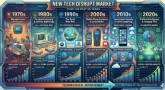
Let’s review the New tech disrupt market over the past 50 years. Below is a list of these industrial revolutions and the tickers of representative companies. My primary criterion is the necessity to “generate substantial wealth” in the stock market, creating sufficient market capitalization and, ideally, representative companies (tickers in bold text below):
- 1980-1990 Privatization of the Telecommunications Industry: NOK, ERIC, QCOM,T,VZ
- 1985-2000 Personal Computer:IBM,INTC,MSFT,AAPL
- 1990-2000 Internet: CSCO,Yahoo,AOL,Netscape
- 1990-2005 Biotechnology: AMGN, BIIB, GILD, Genentech
- 2000-2010 Mobile Communications and Smartphone Applications: APPL, GOOGL,QCOM
- 2006-2015 Cloud Computing and Software as a Service: CRM, AMZN,GOOGL, META, MSFT,BABA
- 2005-2020 E-commerce: EBAY,AMZN, BABA, SHOP, MELI,SE
- 2010-2020 Electric Vehicles: TSLA, BYD
- 2015-Present – Space Technology: SpaceX, AMZN, ASTS, RKLB, SATS
- 2022-Present AI: NVDA,GOOGL,OpenAI, Anthropec
Telecom deregulation
Global deregulation in the telecommunications industry accelerated primarily in the 1980s, with the US and UK leading the way. This process, often referred to as “liberalization,” transformed the telecommunications industry from a state-owned or highly regulated monopoly to a competitive market.
Key Milestones
United States: Liberalization can be traced back to 1948 when the Federal Communications Commission (FCC) decided to allow the use of non-Bell terminal equipment. Large-scale deregulation continued into the 1970s and 1980s, culminating in the landmark Telecommunications Act of 1996.
United Kingdom: In the 1980s, the British government privatized British Telecom and established Oftel in 1984 to regulate market competition.
Japan: Telecommunications liberalization began in 1985, and by 1997, the Japanese telecommunications market had developed into a competitive market with hundreds of new entrants.
New Zealand: In 1989, New Zealand became the world’s first country to completely deregulate its telecommunications market, ending all monopolies.
Regional and Global Waves
European Union: In 1987, the European Union published the Telecommunications Green Paper, launching coordinated action aimed at establishing a single market. By January 1, 1998, most member states had achieved full liberalization of voice telephony and infrastructure.
Latin America and Eastern Europe: In the late 1980s and early 1990s, a “second wave” of reforms emerged, with countries like Argentina, Mexico, and Chile modernizing their infrastructure through the privatization of existing telecommunications operators.
South Asia: Most countries in the region opened their telecommunications markets in the 1990s. Sri Lanka allowed private mobile operators to enter the market in 1989, while India began significantly opening its economy and telecommunications sector in 1991.
WTO Agreement: On February 15, 1997, 69 countries signed the World Trade Organization (WTO) agreement, opening their basic telecommunications markets to foreign competition.
Key Deregulation Events
Region/Country | Major Reform Start Date | Key Legislation or Event
United States | 1970s-1980s | AT&T breakup (1984); Telecommunications Act 1996
United Kingdom | Early 1980s | Privatization of British Telecom; Establishment of Oftel
Japan | 1985 | Introduction of competition, restrictions on NTT’s operations
New Zealand | 1989 | Full market deregulation
European Union | 1987-1998 | Directive 90/388/EEC; Full liberalization in 1998
India | 1991-1997 | Economic liberalization; Establishment of the Telecommunications Regulatory Authority of India (TRAI) (1997)
Internet Commercialization
Commercialization
The Internet began commercialization in the early 1990s, and its full commercialization was marked by the retirement of the NSFNet backbone in 1995. Key milestones included the release of the Internet code in 1993, the establishment of commercial Internet Service Providers (ISPs) in 1991-1992, and the emergence of secure browser technology in 1994.
Key Stages of Commercialization
Early 1990s (Initial Stage): The Commercial Internet Exchange Center (CIX) was established in 1991, allowing networks to exchange traffic without NSF restrictions. Delphi opened full network access to users in 1992.
1993-1994 (Infrastructure and Browsers): In May 1993, CERN released the World Wide Web code (HTML) for free. Released in December 1994, Netscape Navigator introduced secure (HTTPS) communications.
1995 (Full Commercialization): The National Science Foundation Network (NSFNet) ceased operations, and the last restrictions on commercial traffic were lifted. Companies such as AOL, CompuServe, and Prodigy began offering full internet access services to the public.
By the end of 1995, internet infrastructure was largely in private hands, triggering the dot-com bubble.
Mobile computing and cloud
Mobile Communications and mobile app
The development of mobile communications and internet programming began in the mid-to-late 20th century. Commercial mobile communications began with 1G analog systems in the early 1980s, while mobile internet applications developed rapidly with the SMS services of 2G systems in the early 1990s and subsequently with the advent of smartphones in the early 21st century.
The specific development stages are as follows:
- 1982: Commercial Mobile Telephone Systems (AMPS) began operation, ushering in the 1G era.
- Early 1990s: The GSM system was introduced, laying the foundation for 2G digital mobile communications and beginning to support SMS services.
- Late 1990s: CERN launched the first web browser, propelling the development of the global information network.
- Early 21st Century: With the emergence of WAP technology and early smartphones, feature phones began supporting early mobile network applications such as SMS and email.
- Late 2000s-2010s: With the maturity of 3G and 4G technologies and the emergence of smartphone app stores, mobile network formats experienced explosive growth.
In summary, mobile communication technology originated in the 1980s, but the true widespread adoption of mobile network formats began in the 2000s with the rise of smartphones.
Cloud Computing and SaaS
The development of cloud computing and SaaS began in the late 1990s and early 2000s. The concept of SaaS emerged as early as the late 1990s (e.g., Salesforce in 1999), while the term “cloud computing” was formally coined by Google CEO Eric Schmidt in 2006. Subsequently, AWS launched its Elastic Computing cloud service, officially ushering in the era of cloud computing.
Key points of cloud computing and SaaS:
- SaaS (Software as a Service) (Late 1990s – Early 2000s): In 1999, Salesforce pioneered the model of delivering enterprise applications through a browser, and is considered the originator of SaaS.
- Cloud Computing Concept (2006): Google CEO Eric Schmidt formally proposed the term “cloud computing” at the 2006 Search Engine Conference.
- Infrastructure Implementation (2006): In March 2006, Amazon launched its Elastic Compute Service (EC2), ushering in the era of commercialized cloud computing based on Infrastructure as a Service (IaaS).
- Concept Emergence (1980s-1990s): As early as 1983, Sun Microsystems proposed the concept of “The Network is the computer,” foreshadowing the trend of centralized computing resources.
- The rise of these two technologies shifted software and computing power from on-premises deployment to on-demand access via the network, significantly reducing technology costs.
E-commerce
E-commerce began to gain popularity in the mid-1990s with the launch of Amazon (1995) and eBay (1995). Between 2010 and 2020, driven by increased internet penetration, widespread adoption of mobile devices, and improved logistics, e-commerce experienced rapid growth globally, reaching its peak during the COVID-19 pandemic.
Key development milestones are as follows:
- 1980s-1990s: Electronic Data Interchange (EDI) and the Boston Computer Exchange (1982) laid the foundation for e-commerce.
- 1980s-1990s: Global deregulation and privatization of the telecommunications industry.
- Mid-1990s: The emergence of the internet facilitated the creation of Amazon and AuctionWeb (eBay), popularizing online shopping.
- Early 21st Century: The rise of online payment systems and platforms (such as Shopify, 2004) increased the convenience of online shopping.
- 2010s: Mobile commerce (m-commerce) flourished, accelerated by Apple Pay (2014), while Alibaba’s growth solidified its global adoption.
- 2020-Present: The COVID-19 pandemic made e-commerce a necessity, with online sales accounting for a large portion of global retail, evolving from a niche activity in the early 2000s into a dominant industry.
Electric Vehicles
Key Evolutionary History
Electric vehicles have existed for a long time, but their rapid popularization and large-scale application truly began in the 2010s and beyond.
- 2010-2015: The “second golden age” of electric vehicles arrived, with major automakers (GM, BMW, Volkswagen) investing heavily, partly driven by Tesla’s success and environmental awareness. Global sales surpassed one million units in 2016.
- 2017-2020: The release of the Tesla Model 3 in 2017 provided the mass market with a high-performance electric vehicle at a more affordable price. By the end of 2020, global sales reached 10 million vehicles.
- 2021 to Present: The electric vehicle industry has experienced exponential growth, with 2021 sales exceeding the total of the previous five years. By 2023, electric vehicles are projected to account for 10% of the global market share, with China leading in both production and sales.
Factors Driving Popularity
Key factors driving the widespread adoption of modern electric vehicles:
- Advances in battery technology: Lithium-ion batteries have enabled longer driving ranges and higher performance.
- Environmental issues: Increasing awareness of climate change and emissions.
- Government policies: Incentives, tax credits, and future bans on the sale of new internal combustion engine vehicles.
- Charging infrastructure: Continuous development of public and residential charging networks.
Related article
- “New tech disrupt market over the past 50 years“
- “Rules from new technology in 250 years“
- “18 future industry trend and three industries driving billionaire wealth“
- “Inventors are rarely successful, but improvers are successful and profitable“
- “No fear of miss out a great company, No FOMO“
- “Steve Jobs’s Apple innovation gone with him?“
- “Investment knowledge required is breadth, not depth as most people think“
- “Apple’s product design philosophy, How does Apple think?“
- “Why Apple’s new features always come later? “
Disclaimer
- The content of this site is the author’s personal opinions and is for reference only. I am not responsible for the correctness, opinions, and immediacy of the content and information of the article. Readers must make their own judgments.
- I shall not be liable for any damages or other legal liabilities for the direct or indirect losses caused by the readers’ direct or indirect reliance on and reference to the information on this site, or all the responsibilities arising therefrom, as a result of any investment behavior.