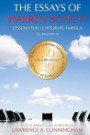
Book Introduction
Introduction to The Essays of Warren Buffett
The Essays of Warren Buffett, written by Lawrence A. Cunningham, was first published thirty years ago.
Author Introduction
Besides The Essays of Warren Buffett, Lawrence A. Cunningham has also written several books related to Warren Buffett, including Dear Shareholder, which I have previously had a post “Dear Shareholder” in this blog post and The Margin of Trust: Warren Buffett’s Profit Model for Berkshire Hathaway.
Content Source
The Essays of Warren Buffett primarily compiles excerpts from Warren Buffett’s letters to Berkshire Hathaway shareholders over the years, categorizing them and compiling them into this book.
Difficulty Level of Content
Because the content of this book is taken verbatim from Warren Buffett’s Berkshire Hathaway annual shareholder letters, and with careful selection and arrangement by Lawrence A. Cunningham to “fully interpret” Buffett’s thoughts, it is not a plain-language, easy-to-read, or easy-to-understand investment book.
If you intend to use this book as your first introduction to stocks for investment novices, be warned: you will likely experience significant frustration.
Importance of this Book
The 101 Book for Buffett Fans
It systematically compiles Buffett’s views on investment and business management, making it one of the best books for studying Buffett’s philosophy. It is a must-read classic for investors who want to understand Buffett’s investment philosophy. This book is included in “Stock Investing Books recommended by Andy Lin“
It wouldn’t be an exaggeration to say that this book is the first book every Buffett fan should read; I myself first read this book in 2000 and have reread it every few years.
Buffett’s comment for the Book
Buffett has highly praised The Essays of Warren Buffett at shareholder meetings, making it one of his most frequently signed and favorite books.
Buffett once said, “Cunningham has compiled our ideas very well. If I had to choose one book to read, I would choose this one.”
Charlie Munger stated that the book is “very practical.”
Buffett’s Comments on Shareholder Meeting
Buffett himself believes that the most representative book about his investment views is perhaps this compilation by Lawrence Cunningham, as it is essentially a rearrangement of Buffett’s own words. His compilation best represents Buffett’s views. We have put about twenty years of annual reports online, as well as articles published in Fortune magazine, and so on.
Buffett believes that his own written views are far better than those rewritten by others, but he still asks readers to make their own judgment. I truly believe Cunningham did an excellent job; he reorganized many reports by topic, making them easier for readers to navigate without having to flip through them year after year.
Key Takeaways from This Book
Overseeing a business is not easy
When selecting directors, companies should prioritize business acumen, interest in the company’s business, and a focus on shareholder interests. However, in reality, directors are often chosen simply because of their prominent positions or ability to enhance board diversity—a flawed approach.
Under Berkshire’s ownership structure, even the best managers can perform better. First, we eliminate the red tape and unproductive activities often associated with the CEO position. Our managers have complete control over their own schedules. Second, we give each CEO a simple task: to run the business based on the following three assumptions:
(1) they are the sole shareholder; (2) the company is the only asset they and their family currently and will own; and (3) the company cannot be sold or merged with another company for at least the next 100 years.
Naturally, we also tell them not to let accounting considerations influence their decisions, even slightly. We want Berkshire’s managers to consider what truly matters, not how these things will be reflected in the financial statements. Choosing the right industry is more important than choosing the right company.
If the premise is wrong, no amount of effort may be of any use. This reminds me of Samuel Johnson’s famous quote: “A horse that can count to ten is a great horse, but not a great mathematician.” Similarly, a textile company that makes wise investments in the textile industry is a great textile company, but not a great enterprise.
From my own experience and observations of other companies, I’ve concluded that industry factors are far more important than management performance in determining a manager’s business performance (measured by return on investment). In other words, which boat you’re on is far more important than how efficiently you row (of course, regardless of the industry environment, intelligence and hard work always play a significant role). If you find yourself on a leaky boat, finding a new boat is usually far more beneficial than struggling to patch the holes.
Not all businesses are destined to increase profits. When the economic foundation of an industry collapses, a talented management team may be able to slow the decline, but the eroding fundamentals will ultimately overwhelm even the best managers. (As a wise friend of mine told me years ago, “If you want to earn the reputation of a great entrepreneur, choose an industry with great potential.”) Currently, the fundamentals of the newspaper industry are absolutely deteriorating, a trend that has already led to a decline in the profits of our Buffalo News, and the downward trend will almost certainly continue.
When Charlie and I were young, the newspaper industry was truly one of the easiest ways to make big money in America. A not-so-great publisher once famously said, “My wealth is thanks to two great American institutions: monopolies and nepotism.” A newspaper that could monopolize the market in a city, no matter how bad the newspaper or how incompetent the management, was guaranteed to make huge profits.
How to mitigate investment risk?
The degree to which the long-term economic health of the business can be reliably assessed.
The degree to which the management’s capabilities can be reliably assessed, including the managers’ ability to fully realize the company’s potential and wisely manage cash flow.
The reliability of management – that is, whether you can trust that managers will deliver results to shareholders, rather than enriching themselves.
Investment cost – the price paid for buying company shares.
Future tax burdens and inflation levels – these will affect investors’ after-tax real return on investment.
Why doesn’t Buffett buy tech stocks?
Charlie and I sometimes believe we can identify whether a company has a long-term competitive advantage, but more often than not, we can’t (sometimes due to a lack of confidence). This is why we don’t buy tech stocks, even though we, like the general public, believe that tech companies’ products and services will change our society. The problem is that we can’t discern which tech companies have a truly sustainable competitive advantage, and this isn’t something we can solve simply by studying hard. It must be pointed out that we’ve never been bothered by our lack of expertise in the tech industry. After all, Charlie and I have many business areas where we lack expertise in capital allocation.
Investing isn’t complicated, but it’s far from easy
If you choose to build your own investment portfolio, there are a few key takeaways to keep in mind. Wise investing isn’t complicated, but it’s far from easy. What investors need to master is the ability to accurately assess the value of specific companies. Note that I said “specific” companies: you don’t need to be an expert on every company, or even familiar with many. You only need to accurately assess the value of a few companies within your scope of expertise. How many companies your scope of expertise covers is not so important; self-awareness is paramount.
Related articles
- “Stock Investing Books recommended by Andy Lin“
- “Dear Shareholder“
- “Buffett Recommended Book List“
- “Amazon top 10 stock investing books“
- “Buffett and Munger recommended books in shareholder meeting“
- “Philip Fisher’s book – Paths to Wealth Through Common Stocks”
- “Buffett archive, meetings, and quotes“
- “The Warren Buffett Portfolio”
- “Stock Investing Books recommended by Andy Lin“
- “Buffett and Munger Unscripted – Selected transcript from Berkshire Hathaway shareholder meeting Q&A “
- “Of Permanent Value”
- “Warren Buffett Speaks”
- “Buffettology”
- “Primer’s book to know Buffett-“Warren Buffett: Investor and Entrepreneur”“
- “Buffett’s most important original book “Tap Dancing to Work”“
- ““Benjamin Graham on Value Investing”, Graham’s bio book“
- “The Chronicle of Buffett Partners “Warren Buffett’s Ground Rules“
- “The Wisdom of Charlie Munger-Key points from Munger Wesco’s 24 years of shareholder meetings“
- “The Charlie Munger Way-Key points from Munger Daily Journal’s 10 years of shareholder meetings“
- “Munger’s most important work “Poor Charlie’s Almanack”“
- ““Damn Right”, Charlie Munger’s biography book“
- “The commonalities of Buffett portfolio – cheap, fixed income, repurchase“
- “Possibility of long-term holdings, Deep dive on Buffett’s case“
- “How Buffett Structures His Long-Term Investment Portfolio“
- “Why Buffett deserves further study?“
- “What helps Buffett to get his investment idea?“
- “Buffett’s 2025 Berkshire Shareholder Letter“
- “Buffett’s 2024 Annual Shareholder Letter“
- “Buffett’s 2023 Annual Shareholder Letter“
- “2024 Berkshire shareholders meeting transcript and video“
- “2023 Berkshire shareholders meeting transcript and video“
- “Buffett’s first TV interview“
- “Full transcript of Buffett’s interview with CNBC’s Squawk Box“
- “Charlie Munger, a great investor worth remembering“
- “Charlie Munger speaks at 2023 Daily Journal Shareholders Meeting“
Disclaimer
- The content of this site is the author’s personal opinions and is for reference only. I am not responsible for the correctness, opinions, and immediacy of the content and information of the article. Readers must make their own judgments.
- I shall not be liable for any damages or other legal liabilities for the direct or indirect losses caused by the readers’ direct or indirect reliance on and reference to the information on this site, or all the responsibilities arising therefrom, as a result of any investment behavior.