Reasons to Recommend This Book
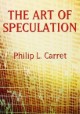
- Completed a century ago in 1930, “The Art of Speculation” has become a Western investment classic and remains enduringly popular.
- Although many of the industries and companies discussed in the book have vanished or been acquired, I personally believe that almost all of the principles, content, and insights on stock market investing discussed in the book are still applicable today—proving that the fundamental principles and theories of stock market investing never fade or become obsolete. Its value has only increased with the test of readers over the past century and the testament of time.
- It even has a 4.5 rating on Amazon, which is quite impressive.
- The book isn’t long; I personally finished it in three hours. I think it’s suitable for aspiring stock investors, beginners, or anyone at any level who wants to fully understand the market and stock investing in one book.
- Buffett: “Carret has the best long-term investment record of anyone I know.”
About the Author: Carret
- Philip Carret founded Pioneer in 1928, which later evolved into Fidelity Mutual Trust, long a top-ranked American mutual fund company.
- During Carret’s 55 years at the helm, the fund’s assets grew from $10,000 to $8 million.
- The secret to Carret’s investment success was his ability to identify the value of small companies with great potential before others and to hold on to their shares.
- Carret experienced 31 bull markets, 30 bear markets, 20 recessions, and a depression, even surviving the financial crisis of 1929.
Carret’s 12 Rules for Speculators
- It is best to hold securities in at least 10 companies across five different industries.
- Reassess your holdings at least every six months.
- Keep at least half of your funds in securities that generate a fixed income.
- When analyzing stocks, consider yield as the least important factor.
- Cut losses quickly; don’t rush to take profits.
- Never invest more than 25% of your funds in a security where detailed information is difficult to obtain and not regularly published.
- Avoid “inside information” like the plague.
- Seek facts, not advice.
- When evaluating securities, ignore rigid formulas.
- When stock prices are high, interest rates are rising, and the economy is booming, keep at least half of your funds in short-term bonds.
- Unless stock prices are low, interest rates are low, and the economy is depressed, be cautious about borrowing money to buy stocks.If a company has a good outlook, allocate an appropriate proportion of your funds to long-term equity.
Key ideas and experience sharing
- If you only view speculation as a workable method to gain any benefits, you will not succeed. Successful investing requires capital, courage, and judgment—a speculator must possess all three. Good judgment isn’t simply innate; it must be cultivated to understand the complexities of the financial industry.
- When speculating, the path to success lies in studying value. Successful speculators buy or hold securities priced below their true value and avoid buying or selling securities priced far above their true value. Successful investors must also follow this strategy. Some seek long-term returns and should buy undervalued securities rather than those that fully reflect their true value. When undervalued securities adjust to their true value, those seeking capital gains profit. It takes time for prices to adjust to their true value.
- Leonard Ayres discovered the relationship between stock prices, dividend yields, and the market. The average return is calculated by dividing the Dow Jones Industrial Average’s stock price by the total dividends of its components. In bull markets, dividend yields are low, while in bear markets, they are high. Over the past thirty years, only one bull market has failed to push this index above 20 points, and every bear market has driven it below 17 points. Once a market trend is established, a minimum limit for this index can be set based on this fact.
- In practice, pyramid financing can never achieve its theoretical maximum, allowing clients to continue to raise margin indefinitely as stock prices rise. Brokerage firms may be happy to allow clients to trade with a 20% margin, but this does not mean that traders are safe from losses within 20%. On the contrary, as soon as the decline of any individual stock threatens 20% of their equity, the brokerage firm will begin to call for margin to protect its own safety.
- When the stock market is falling, there are many current stockholders, but fewer when it is rising. If the percentage held by brokerage firms is sufficient to represent the number of shares in margin accounts, it is clear that there are more shares when the market is rising and fewer shares when it is falling. This may be because more and more people view common stocks as long-term investments.
- Since brokerage firms began reporting margin balances, there have been four instances where margin balances increased significantly more than stock prices. Each time this occurred, the market plummeted within the following sixty days.
- Technical analysis charts, such as line charts, generally fail to provide definitive technical indicators because they are based on hindsight.
- Investing is an art form, and interpreting market behavior is more of an art form than a science. Technical factors cannot be reduced to a set of simple rules. Those who study technical analysis typically focus solely on short-term stock price fluctuations. Over the long term, the ability to draw accurate inferences from economic fundamentals can yield substantial profits. Combined with the ability to analyze technical market conditions, even long-term traders can significantly increase their profits.
- Short selling minimizes stock market volatility. At the end of a bull market, excited investors can drive stock prices skyrocketing, completely disregarding value. Short selling, however, can help the market regain its composure, expose weaknesses, and provide timely warnings to investors. Conversely, when the market is overly pessimistic, timid investors hold off buying for fear of further declines. In such extreme market conditions, short-covering buying can be a significant force, perhaps even enough to halt the decline.
- It’s difficult for short sellers to profit from long-term short selling because bull markets almost always outlast bear markets. Long-term short sellers have to fight the long-term trend of rising values, and their chances of profit are far lower than those of long-only traders.
- Depreciation is perhaps the most important accounting item on the income statement. While other items are more or less beyond the control of senior management, every dollar of depreciation is determined by them. If performance is poor, the depreciation provision can be reduced to improve the balance sheet.
Related articles
- “The Art of Speculation”
- ““A Random Walk Down Wall Street” is a must-read for US stock investors“
- “Great primer books for Investing in the stock market“
- ““One Up on Wall Street”, Peter Lynch’s great book for investing newbie“
- ““Benjamin Graham on Value Investing”, Graham’s bio book“
- “Charles Ellis and his “Winning the Loser’s Game” “
- “Investors should care annualized rate of return (IRR), calculate with free IRR Calculator“
- “What information should investors document?“
- “A investor can be sustained or not? how to verify?“
- “Global stock markets performance comparision over the past 30 years in a table“
- “S&P 500 vs. Nasdaq 100 index, how to choose a market index?“
- “S&P 500 index next year performance, based on last century record“
- “Return rate comparison among Buffett portfolio, Berkshire stock price, S&P 500 over the years“
- “2022 S&P 500 Constitutent Stocks Performance“
- “Stocks Better than the S&P 500, Procter & Gamble (P&G)
- “S&P 500 vs. Nasdaq 100 index, how to choose a market index?“
- “S&P 500 index, the only stock worth holding forever“
- “Querier to Annualized rate of return for S&P 500 Index“
- “Querier to Annualized rate of return for Dow Jones Industrial Average (DJIA) Index“
- “Querier to Annualized rate of return for Nasdaq Index“
- “S&P 500 P/E ratio has been rising in the past century, S&P 500 PE Ratio and Average Querier“
- “Querier to Annualized rate of return for Philadelphia Semiconductor Index (SOX)“
- “A table comparing S&P 500, Nasdaq, Dow Jones, Philadelphia Semiconductor Index over the years since its inception and annualized returns“
- “Investors should care annualized rate of return (IRR), How to calculate?“
- “Most investors should invest ETFs tracking broader market“
- “US issued ETFs tracking US market is your best bet“
- “Top 10 ETFs and important major US stock market index“
- “Querier to Annualized rate of return for Taiwan Stock Exchange“
- “How does BlackRock, the world’s largest index and asset management company, make money?”
Disclaimer
- The content of this site is the author’s personal opinions and is for reference only. I am not responsible for the correctness, opinions, and immediacy of the content and information of the article. Readers must make their own judgments.
- I shall not be liable for any damages or other legal liabilities for the direct or indirect losses caused by the readers’ direct or indirect reliance on and reference to the information on this site, or all the responsibilities arising therefrom, as a result of any investment behavior.