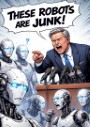
Outrageous Ignorance Remarks
Revisiting C. C. Wei’s Original Wording
On March 21, 2026, during a speech at Asia University’s 25th anniversary celebration, TSMC CEO appalling remarks on Chinese robots:
Don’t touch what you don’t understand
Investors all know the saying, “Don’t touch what you don’t understand.” This actually comes from Warren Buffett’s concept of “circle of competence” and Charlie Munger’s emphasis on the same concept, stressing that investors should focus on companies they understand to minimize risk.
As the leader of Taiwan’s largest enterprise and the world’s largest semiconductor foundry, he made such arrogant, ignorant, and conceited remarks that even shocked experts in the field. If you don’t understand something, don’t speak recklessly; keep quiet. At least you won’t let people discover you’re an incompetent fool or cause a major disaster.
Such remarks are nothing short of the absurdity of those suffering from big head syndrome, no different from the typical online trolls! Such utter ignorance of the rapid development and capabilities of humanoid robots, coupled with their deliberate and blatant denigration of China’s achievements in this field, is truly disheartening.
According to Wei’s logic, his controversial remarks are just like some people’s said “China’s drones flying around are “useless, just for show.” But what changed the way humans wage war during the four-year Russia-Ukraine conflict? What helped Iran resist the invasions of the United States and Israel? The focus of these two most important wars in recent years was drones !
Drones are basically flying robots! China’s DJI drones hold a 70% to 85% market share globally, especially in major markets like North America, Europe, and Asia, where they enjoy an absolute monopoly.
US embargoes anything not able to compete with China
Drones
Because of absolute monopoly of Chinese droves, this has led to a ban on their use in the United States. However, due to the ban, many US government enforcement agencies and private companies have been unable to find alternatives. According to a report in January 2026, the US Department of Commerce quietly withdrew its original plan to impose strict import restrictions on DJI drones.
US Military Bans Unitree Robotics
The inclusion of the Chinese humanoid robot company Unitree Robotics on the US military’s Unreliable Entities List in 2026 underscores the military’s concerns.
Law Bans Chinese Unmanned Ground Vehicle Robots
On March 26, 2026, two US senators introduced legislation to ban the US government from purchasing and operating humanoid robots manufactured in China. The sponsors are Senator Tim Cotton, the third-ranking Republican senator from Arkansas, and Senator Chuck Schumer, the Democratic Whip from New York. Their proposal, officially titled the “Safe Robots for America Act,” aims to prohibit the federal government from purchasing or using unmanned ground vehicles manufactured by rival countries such as China, and also prohibits federal funds from being used for related robots.
Practicality of Humanoid Robots
Well-known Humanoid Robots vendors
Unitree Robotics (宇樹科技), UBTech (優必選), Tesla, and Boston Dynamics (a subsidiary of Hyundai) are among the most well-known Humanoid Robots vendors. For details, please see my post of “Humanoid Robots current status and vendors“
Humanoid Robots are Difficult to Develop
Humanoid robots differ from industrial robots. Industrial robots (including those used in the automotive and semiconductor industries for decades) have relatively simple application scenarios and are easier to develop.
However, the difficulty of humanoid robots lies in the requirement for a high degree of realism, making them the most challenging type of robot to develop. For example, the world has not yet developed a robot capable of folding clothes—a seemingly simple task for humans. This illustrates just how difficult humanoid robots are to develop.
On March 18, 2026, GalBot, a Chinese robotics company, released a video of a humanoid robot playing against a human on a tennis court. Those interested can click here to think about the complex technology involved.
Current Applications of Humanoid Robots
To date, to my knowledge, humanoid robots or near-humanoid robots with four-limb mobility are currently used in applications including: combat(Haven’t the US, China, Russia, Ukraine, and Iran all proven this to everyone?), cooking, logistics, tour guiding, housekeeping, catering, heavy cargo handling in factories, and transportation in scenic areas.
A prominent Chinese humanoid robot company, UBTECH, has announced that its humanoid robots have been adopted by several world-renowned clients in five major scenarios: aerospace manufacturing, automotive manufacturing, 3C electronics manufacturing, smart logistics, and semiconductor manufacturing.
UBTECH’s astonishing packages to top talent
In early April 2026, UBTECH, a leading Chinese humanoid robot manufacturer, publicly recruited a Chief Scientist for Embodied Intelligence globally, offering annual salaries starting at RMB 15 million and reaching a maximum of RMB 124 million.
These salary figures not only break records for top talent in China’s robotics field but also rival the salaries of top scientists at global tech giants like OpenAI and Meta.
If, as Wei stated, Chinese robots are “useless and just for show,” how can UBTECH have the capability, or why is it so confident in offering salaries comparable to OpenAI and Meta to recruit top talent worldwide? UBTECH is a publicly listed company, not a state-owned enterprise, private company, or SME; any expenditure must be reviewed by the board of directors and shareholders.
Humanoid Robots in China
Humanoid Robots Realizing Physical AI
At the 2026 Spring Festival Gala in mainland China, humanoid robots from four mainland companies took to the stage. In addition to spectacular performances such as martial arts, tens of thousands of drones, coordinated with AI, lit up the night sky. Former Google CEO Eric Schmidt believes this is not just a festive entertainment event, but is also seen as an important signal that “physical AI” is rapidly rising, symbolizing that artificial intelligence technology is gradually moving from the digital world to the real world.
The core of “physical AI” is enabling AI to not only understand text and images, but also to act in the real world. Nvidia CEO Jensen Huang has divided AI development into four stages: perceptual AI, generative AI, agent AI, and ultimately, physical AI.
China has established its own supply chain
Mainland China has demonstrated a significant advantage in the field of physical AI. Its strong manufacturing capabilities and complete supply chain have significantly reduced the cost of robot-related hardware. Driven by the rapid development of the electric vehicle industry, mainland China has achieved mass production of key components such as actuators (the actuator accounts for approximately 40% of the total cost of the humanoid robot), sensors, and batteries, reducing costs by more than half.
Eric Schmidt’s article points out that mainland China has now mastered important links in the robotics industry chain. For example, in the LiDAR market, mainland companies account for approximately 70% of the global market. Furthermore, Suzhou-based L.H. Electronics (領航電⼦) has become one of the world’s leading manufacturers of harmonic reducers, Shanghai-based Eyou Robotics (億友機器⼈) has established the world’s first automated production line for humanoid robot joints, and Estun and Inovance Technology are gradually becoming important manufacturers of robot control systems.
Patents
China accounts for two-thirds of global robot patent applications and is the world’s largest producer of industrial robots, with prices ten times lower than their Japanese and American counterparts. The article projects a $5 trillion global business opportunity over the next five years.
How strong is China’s in humanoid robot?
In 2025, the global shipment of humanoid robots will reach approximately 13,000 units, with China accounting for as much as 90%, leading its American competitors, including Tesla’s Optimus humanoid robot.
In early 2026, Elon Musk identified Chinese manufacturers as the primary threat to Tesla’s Optimus humanoid robot, calling them “next level” and acknowledging them as the toughest competitors in the field. Musk stated he saw no significant competitors outside China, emphasizing their manufacturing prowess and potential to dominate the industry. Tesla CEO Musk said: “The biggest competitors in the humanoid robot field will come from China.“
Tesla CEO Elon Musk admitted in his first earnings call in April 2025 that despite Tesla’s “Optimus” robot leading the way, China may eventually dominate the industry. He said: “I am a little worried that the companies from second to tenth may all be from China.”
TSMC Doesn’t Dominate the Robotics Industry
The vast majority of chips used in robots don’t require the most advanced manufacturing processes; mature processes are the majority. This is because the chip manufacturers that rely on sensors, microprocessors, IoT, and industrial chips (such as STMicroelectronics, Bosch, NXP, Texas Instruments, Infineon, and a bunch of Chinese domestic manufacturers) all use 28nm or even 40nm processes. STMicroelectronics, unable to compete with Chinese manufacturers in its own production, announced that its 40nm MCUs would be manufactured by Huahong Semiconductor, effectively shutting down its own chip factory in Europe.
Besides chips, humanoid robots have even more important components that Taiwan cannot produce or control.
Wei’s statement that “TSMC makes the brains of 95% of robots” is simply not true; Wei is far too arrogant.
Furthermore, Wei was reminded that TSMC itself has long been using cutting-edge equipment from Chinese semiconductor equipment manufacturers on its various advanced process production lines, and not just one.
What about Taiwan’s humanoid robots?
Please see my post of “What about Taiwan humanoid robots?“
More In-Depth Robotics Articles
Since this blog has already covered this topic extensively, I don’t intend to repeat it here. Readers interested in this topic can refer to the following previous posts on this blog:
- “What about Taiwan humanoid robots?“
- “Top Chinese Robotics Companies“
- “Top 10 Robotics Companies in the World“
- “Humanoid Robots current status and vendors“
- “Robot industry current status and application“
Control Group: Jensen Huang
Geopolitics
Obstacles argue that Nvidia has significant commercial interests in China (China accounts for 20% of Nvidia’s revenue), and that this was a necessary move to appease China.
However, looking at major publicly listed companies in the United States, which CEO doesn’t make such a statement? Even if they have withdrawn from the Chinese market or the Chinese market accounts for a small percentage of their revenue, they wouldn’t be so reckless as to publicly make a statement like Wei’s.
Incorrect Statements on Quantum Computing
Jensen Huang admitted his views on quantum computing were incorrect and was willing to admit his mistake. At the “Quantum Day” at the 2025 GTC conference, Huang publicly apologized for his previous pessimistic view that the commercialization of quantum computing was “too early,” humorously stating that he was “completely wrong” at the time. He revised his previous statements, acknowledging that the practical application of quantum technology is “now,” not 15-30 years from now, demonstrating his renewed optimism about the future potential of quantum computing.
Furthermore, Jensen Huang, due to the controversy surrounding quantum computing, realized its future importance. To avoid missing out on quantum computing, he announced that Nvidia would enter the field and collaborate with existing quantum computing companies.
Huang Admits “Without China, American Robots Can’t Even Hold Their Heads”
A Wall Street Journal article published on April 2nd stated that “both China and the United States consider humanoid robots a strategic industry, and the rapid development of humanoid robots in China is making it difficult for American robots to operate without “Made in China.” While the U.S. currently maintains a lead in AI chip development, Chinese manufacturers are dominating the production of physical components necessary for humanoid functionality.”
In March 2026, Nvidia CEO Jensen Huang showcased a robotic version of Olaf, the Yeti from the movie Frozen, at Nvidia’s annual GTC conference. This robot brought together three of America’s most well-known companies: Disney provided the character, and Nvidia and Google provided the artificial intelligence technology.
But this robot also showcased China’s strength. According to a Disney paper, without components from Chinese robot manufacturer Unitree Robotics to drive its neck and leg movements, Olaf could not walk or move its body.
Even now, Figure AI, the leading humanoid robot company in the United States, uses Chinese suppliers for robot joints, sensors, and motors. Almost all the parts for Tesla’s humanoid robot Optimus also come from China.
In a podcast in March 2026, Jensen Huang frankly stated that China “is the best in the world in the fundamental links of the robotics industry, such as microelectronics, motors, rare earths, and magnets,” and that “the world’s robotics industry will have to rely on it to a large extent.”
Damage TSMC’s enormous interests in China
How large are TSMC’s interests in China?
TSMC has enormous commercial interests in China, numbers even larger than most US-listed companies.
- In the second quarter of 2024, the Chinese market accounted for 16% of its total revenue. Before US action against TSMC to ban Huawei in the second quarter of 2018, the Chinese market accounted for as much as 21% of its revenue!
- In 2025, TSMC’s mainland China subsidiaries are projected to generate NT$11.638 billion in profit, with the Nanjing plant contributing NT$27.453 billion, making it the most profitable overseas facility. In contrast, the Arizona plant in the US returned to profitability for the first time, generating NT$16.141 billion in profit; the Kumamoto plant in Japan (JASM) suffered a loss of NT$9.767 billion; and the German plant (ESMC) incurred a loss of NT$688 million.
Opponents’ Arguments
Regarding my previous statement about TSMC’s significant commercial interests in China, opponents argue that China relies on TSMC, so there’s no need to worry; China simply needs TSMC (China doesn’t need TSMC at all for legacy chip manufacturing processes, because China is already the world’s largest country with lagacy chip manufacturing processes.). This is currently true—most advanced manufacturing processes rely on TSMC. However, anyone paying attention to current events knows this will not be the case in the foreseeable future.
Please note: TSMC does not have 100% complete control over the global production of advanced chip manufacturing processes; moreover, within a few years, there is a very high probability that TSMC will no longer be able to maintain its near-monopoly on the production of all advanced chip manufacturing processes worldwide. Because if you follow industry dynamics, you should know that besides China, Japan, the United States, and South Korea will catch up with TSMC in the foreseeable future, at least taking a significant share of TSMC’s existing advanced chip manufacturing capacity—this is currently underway.
China’s Progress
TSMC Cuts Off Chinese Customers
Besides the repeated obstruction by the US of TSMC’s Nanjing plant upgrading its 16nm process to more advanced technologies, the US has been constantly directing TSMC’s moves in recent years. In addition to the existing embargo on Huawei, the US has successively prohibited TSMC from manufacturing advanced processes for more Chinese companies. The latest news is that China’s domestic GPU manufacturer, Biren Technology, has also been banned from placing orders for 7nm processes with TSMC.
China Can Already Produce 5nm and 7nm
However, I want to remind TSMC investors that SMIC began producing 7nm chips in July 2021 and will begin producing 5nm chips by the end of 2025. Huahong Grace Semiconductor’s subsidiary, HLMC, also plans to begin initial mass production of 7nm chips by the end of 2026.
If China had EUV…
I want to remind investors again: If the US ever lifts its semiconductor embargo on China, China will be able to obtain all the EUV equipment that TSMC can acquire; or China will develop compatible EUV equipment (one of these two options is inevitable). Do you think that SMIC and Huahong, currently inexperienced, cannot produce more advanced processes? Can’t yield rates be improved? Who has the advantage in terms of scale and cost?
Perhaps some will say it’s impossible to surpass TSMC. Just three or five years ago, who in the world would have predicted that the global automotive industry and Volkswagen and Tesla would be overthrown by the Chinese automotive industry? Ending Japan’s 25-year lead and becoming the world’s largest automaker by 2025?
Please note: The discussion here includes not only electric vehicles, but also traditional gasoline-powered vehicles.
Humanoid robots are now an ongoing process.
If China bans rare earth exports to Taiwan
have investors considered the consequences? Taiwan’s semiconductor industry would have to grind to a halt. Would the Wei family still be so arrogant then? I believe the Taiwanese government hasn’t considered this, and given the Wei family’s limited vision, they wouldn’t be able to come up with a solution.
Most readers might think I’m overblown. Ask U.S. government would provide the answer.
Most readers might think I’m overblown, ask U.S., Japan, or South Korea would reveal the impact of the rare earth embargo on the semiconductor industry.
TSMC’s Advanced Process No Longer Monopoly
TSMC Submits to US Directives
SMIC’s “advanced process” yield is constrained by the US-mandated EUV embargo against China imposed by the Netherlands, making it difficult to meet China’s demand in the short term. TSMC, in turn, obeys the US, repeatedly using various excuses to refuse, delay, and reject, while being picky about Chinese customers; deliberately hindering China’s chip demand.
Samsung’s 2nm Yield Approaches TSMC’s
Samsung’s 2nm process yield has now reached 60%, not far from TSMC’s 60% to 70%; coupled with Japan’s Rapitus successfully producing 2nm chips this year, TSMC’s near-monopoly in advanced process technology is no longer intact.
Chinese Customers Turn to Samsung
While it’s true that China largely relies on TSMC for “advanced process technology,” many Chinese customers have recently switched to Samsung, no longer dependent on TSMC. Among the most well-known are many Chinese cryptocurrency companies with huge demand for advanced process chips, as well as Alibaba and ByteDance, which have already placed orders with Samsung for advanced process chips.
Closing words
Useless? Why US ban Unitree?
The fact that the Chinese humanoid robot company Unitree Robotics was added to the US military’s Unreliable Entities List in 2026 demonstrates the US military’s concerns. If, as Wei claims, Chinese robots jumping around are “useless, just for show,” then why did the US launch such a high-profile ban on Unitree Robotics?
Double standard
I’m curious if Wei would dare to use the same sarcastic tone to mock any of the American robotics companies like Optimus, Figure AI, and Boston Dynamics. Especially considering that the humanoid robots from these American companies are far inferior in function and quality to their Chinese counterparts.
What I’m even more curious about is: TSMC in Taiwan currently holds a near-monopoly on all high-end chip manufacturing. Has Wei considered the quality of Taiwan’s own humanoid robots? According to his original statement mocking Chinese humanoid robots, Taiwan produces 95% of the robot brains. So what about the quality of humanoid robots made in Taiwan? Can a humanoid robot be made with only a brain, without hands, feet, body, joints, sensors, and actuators?
This is why I say Wei clearly is double standards.
Like online trolls
It’s truly baffling why Wei made such a statement. Perhaps, as analyzed in this article, he genuinely doesn’t understand the field of robotics. However, it’s also possible he wanted to demonstrate political correctness to the current ruling authorities, or perhaps he was deliberately downplaying China’s achievements to curry favor with the US. His true purpose and intentions remain unknown; only Wei himself knows. Of course, he may not even realize the enormity of his actions.
Don’t bury your head in the sand like an ostrich, or be narrow-minded like someone in a well, and make statements that are detached from the truth. The world won’t stop turning just because you’re ignorant, and slandering others won’t stop their progress.
Completely unfit
This article cites Jensen Huang as an example. Investors should consider: would any of the following individuals—Apple’s Cook, Microsoft’s Nadella, Alphabet’s Pichai, or Broadcom’s Hock E. Tan—make such inappropriate remarks? In the history of US-listed companies, there are countless examples of people resigning due to inappropriate, seriously damaging, or harmful statements.
Being cautious in speech and action is a fundamental ability that every business leader must possess! However, for a large listed company like TSMC, Wei’s remarks were clearly inappropriate and unbecoming, and he has already made a serious mistake with his words, causing TSMC’s image and real damage without even realizing it.
Behavior like a nouveau riche
This is not the first time Wei, known for his outspokenness, has made a gaffe, nor is it the first time he has publicly denigrated other companies with a sarcastic, arrogant, and high-profile tone. Insiders know that Wei’s rise to his position and TSMC’s current dominance in high-end chip manufacturing are the result of numerous factors—the visionary planning of many excellent bureaucrats during the Kuomintang era fifty years ago, US approval, the massive resource investment from Taiwan, and the sacrifices of Taiwanese engineers.
Wei simply hasn’t grasped the point (given his limited vision, character, and actions, it’s like trying to get fish from a tree), that TSMC’s current position isn’t due to his personal achievements. It’s similar to Buffett’s view on the management of large, well-established companies: frankly, unlike twenty years ago, at TSMC now, anyone could be the CEO; it’s not indispensable.
Without Wei, TSMC would still be TSMC; but without TSMC CEO’s title, Wei’d just be a nobody.
Incapable of self-reflection
As Intel founder Andy Grove famously said: “Success breeds complacency. Complacency breeds failure. Only the paranoid survive.” Wei is not qualified. He simply lacked that level of vision and perspective.
Buffett said: “It takes twenty years to build a reputation and five minutes to ruin it. If you think about that you’ll do things differently.”
Related articles
- “SK Hynix dominates memory by AI“
- “TSMC has notorious tracking record of violating Labor Law“
- “What about Taiwan humanoid robots?“
- “TSMC CEO appalling remarks on Chinese robots, inferiority to nVidia Huang“
- “SkyWater, 3D chip leader and the only pure-play US chip foundry“
- “Top Chinese Robotics Companies“
- “Top 10 Robotics Companies in the World“
- “Humanoid Robots current status and vendors“
- “Robot industry current status and application“
- “What does book “Chip War” talk about?“
- “How was TSMC originally founded? Not by Morris Chang“
- “TSMC risks and disadvantages in Taiwan“
- “TSMC Morris Chang’s controversial words and deeds“
- “165 billions investment proved TSMC moat and competitiveness is fragile“
- “TSMC Advanced Packaging Evolution History“
- “How important is semiconductor industry to Taiwan?“
- “TSMC is becoming the lord of semiconductor packaging, in addition to foundry“
- “Taiwan’s abandoned nuclear hit TSMC hard, profit margins decrease 1% by electricity price increase“
- “Rapidus will be TSMC’s strongest rival in the future“
- “ASML, who dominate TSMC’s fate“
- “Mong-Song Liang, the hero of SMIC’s breakthrough in US blockade“
- “TSMC negative toxic corp culture and management style are detrimental to its future and growth“
- “Why is TSMC valuation much lower than US peers?“
- “What’s TSMC DCF intrinsic value?How to calculate it quickly with a free tool?“
- “How many fabs and houses does TSMC have currently and in the future?“
- “Yield rate comparison of SMIC, Rapidus, TSMC, Samsung, Intel’s advanced process“
- “The TSMC cost, sell price, and R&D cost of chip foundry“
- “Comparison of SMIC, Rapidus, TSMC, Intel, and Samsung’s new process roadmaps for future chips“
- “Two long-term threats to TSMC: US and SMIC“
- “Why is TSMC’s profit margin much greater than competitors?“
- “How does TSMC make money?“
- “Zyvex and sub-nanometer semiconductor processes, will Zyvex threat TSMC?“
- “TSMC gets emerging and serious challenges“
Disclaimer
- The content of this site is the author’s personal opinions and is for reference only. I am not responsible for the correctness, opinions, and immediacy of the content and information of the article. Readers must make their own judgments.
- I shall not be liable for any damages or other legal liabilities for the direct or indirect losses caused by the readers’ direct or indirect reliance on and reference to the information on this site, or all the responsibilities arising therefrom, as a result of any investment behavior.